
Can You Sell PLR on Etsy?
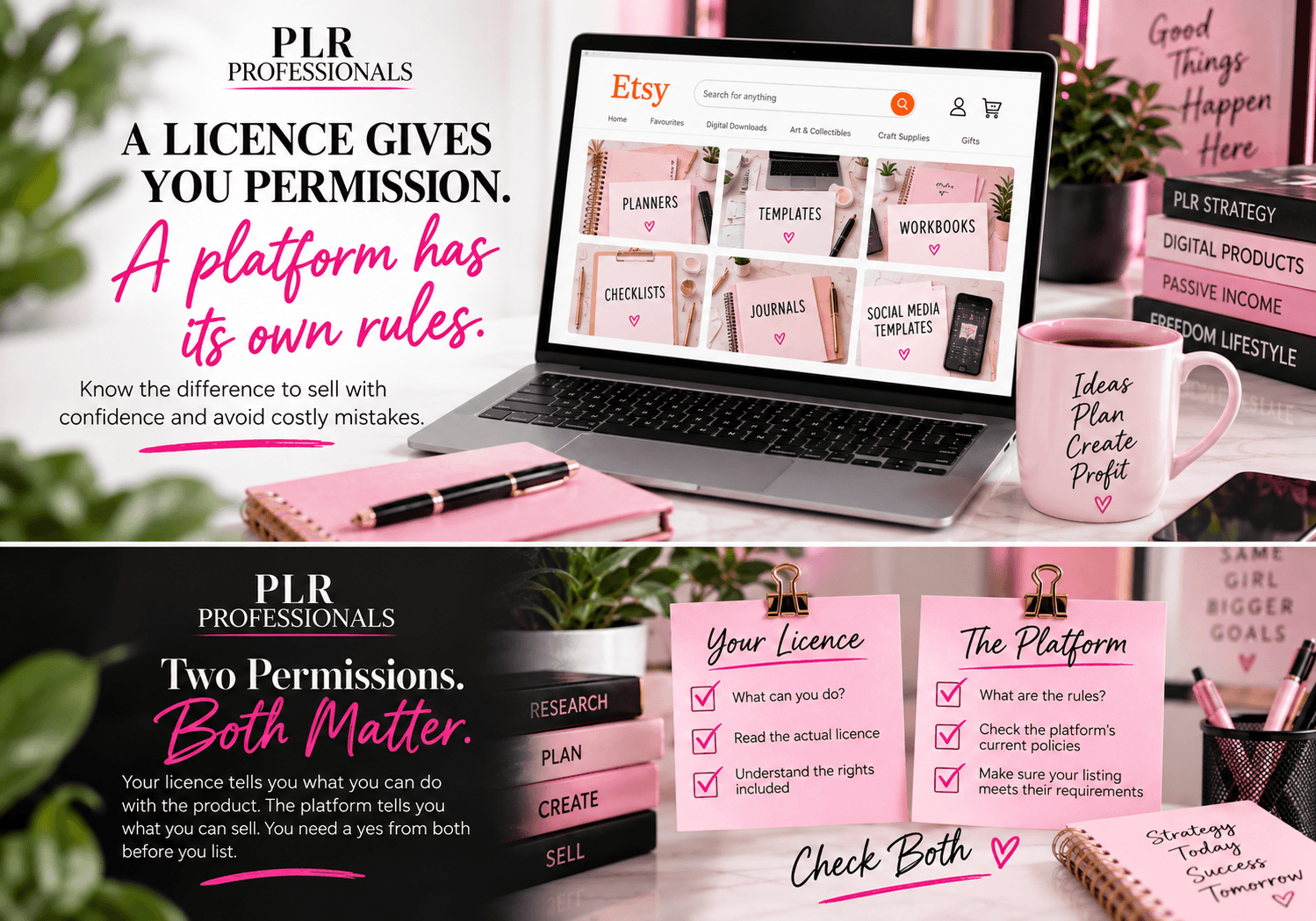
If you've bought a PLR or MRR product with resale rights attached, it's completely reasonable to assume that means you're clear to sell it wherever you normally sell digital products. The licence says you can resell it. So you list it. Simple.
Except it isn't quite that simple, and this is one of the most genuinely easy things to misunderstand in this space.
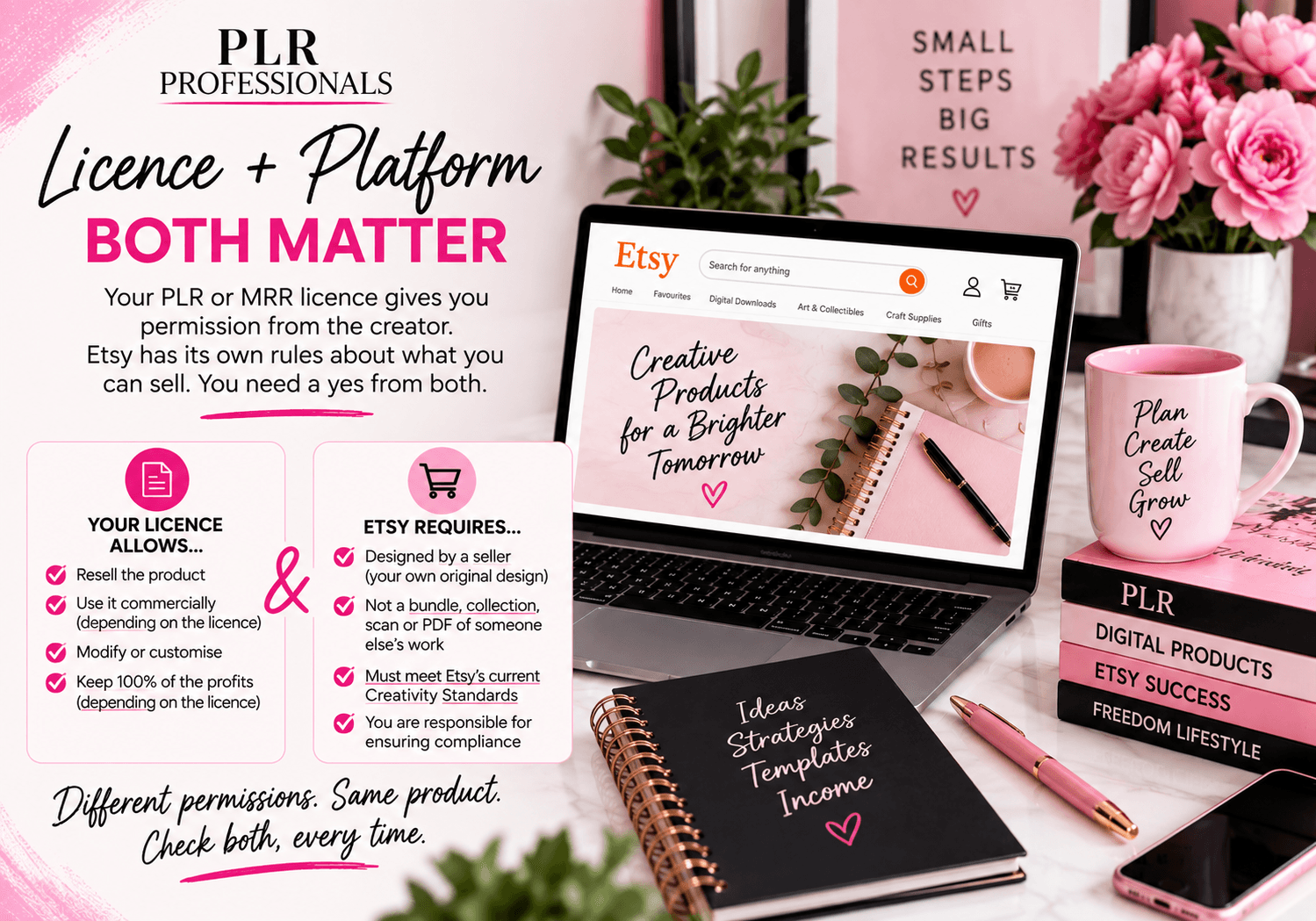
A licence and a platform's listing rules are two separate permissions. One comes from whoever created and licensed the product. The other comes from the marketplace where you're choosing to sell it. Having permission from one doesn't automatically mean you're compliant with the other.
This isn't a dig at PLR or MRR. I think these resources can be genuinely useful when you use them well, and I'm not about to tell you otherwise. But there's a way PLR and MRR sometimes get marketed that skips straight past this point entirely: you have resale rights, so now go list it and sell it. As if the licence is the end of the conversation.
It isn't. The licence tells you what the creator or licensor is permitting you to do with their product. It doesn't tell you anything about the rules of the platform you're planning to sell it on. Those are set separately, by the platform, and they don't bend to accommodate what your licence says.
Etsy is a genuinely useful, current example of exactly this gap. So let's actually look at it.
What Etsy requires in 2026
Etsy's Creativity Standards sit inside its Terms of Use, and every listing has to fall into one of four categories:
Made by a seller — physical items you've crafted, altered, or assembled yourself
Designed by a seller — your own original designs, whether produced by a third party or sold as a digital download
Handpicked by a seller — vintage items and certain curated collections
Sourced by a seller — craft supplies, party supplies, and items personalised with a buyer's own text or image
For anyone selling digital products, the category that matters is "Designed by a seller." And this is where the licence-versus-platform distinction gets concrete.
Etsy's own policy is specific about what qualifies here: your own original designs, sold as a digital download, produced by a production partner, or created through your own AI prompts. The word doing the work is "your." The design has to be yours.
Etsy is equally specific about what doesn't qualify. Among the examples it gives: a bundle, collection, scan, or PDF of someone else's work.
That's the gap, stated plainly: simply holding resale rights to someone else's work doesn't by itself make that work your original design under Etsy's standard. What matters isn't whether your licence permits resale. It's whether the specific item you're listing is actually your own design, as Etsy defines it. Your licence can give you permission to resell a product. It can't tell Etsy, or any other platform, that the product counts as your original design.
What this doesn't mean
I want to be careful here, because it would be easy to take this too far in the other direction and start treating it like a formula. It isn't one.
Etsy hasn't published a PLR-specific customisation threshold, and I'm not going to invent one on your behalf. There's no official percentage, no checklist, no "change five things and you're covered." Anyone telling you there is one is guessing.
What actually governs whether a listing qualifies is Etsy's own current Creativity Standards, applied to your actual product. That's the only authority that matters here, not a generic rule of thumb, including any rule of thumb from this article. If you're unsure whether a specific item you've created would qualify, the accurate answer is to read Etsy's current Creativity Standards yourself and assess your actual listing against what it actually says today. Policies get updated. Your product is specific. Go to the source.
The bigger habit this is really about
Etsy is the example, not the whole point. The real lesson applies everywhere you might use a licensed resource, not just on Etsy, and not just with PLR.
Before you list, publish, or use anything you didn't create yourself, it's worth running through three questions:
What does my licence allow? Read the actual licence attached to the actual product. Not what you assume the category label means. The licence itself.
What does the platform require? Every platform you sell or publish on has its own rules about originality, sourcing, and disclosure. Those rules exist independently of any licence you're holding.
Does what I'm planning to sell satisfy both? Not one or the other. Both. A yes from your licence and a yes from the platform are two different checks, and you need to clear both of them separately.
This habit isn't about being suspicious of PLR or MRR, and it isn't about being scared of Etsy. It's about being accurate. A licence is real permission from the person who created or licensed the product. It's genuinely valuable. It just isn't the only permission that matters once you decide where you're going to sell.
PLR and MRR aren't the problem here, and neither is Etsy. The problem only shows up when the licence gets treated as if it settles everything, when really it only ever answered one of the two questions you needed to ask.
Know what your licence gives you. Know what your platform requires. Check both, every time, for every product. That's the whole habit, and it'll serve you well beyond this one example.
If you've run into this gap yourself, or you're double-checking a product right now, I'd love to hear how you're navigating it. Save this one for the next time you're about to list something.
Written by:
Gaye Fern_PLR Professionals Founder
Categories

Trending
Here's What "Designed by a Seller" Actually Requires.
Your Plan for Using Them Isn't.
It's easy to look at a PLR product and immediately start imagining everything you could do with it

About me

Hi there 👋 My name is Gaye. PLR Professionals is here to help digital product creators use PLR, MRR and ready-made resources with more clarity and confidence. Find practical guidance on licensing, customisation, digital product strategy, marketing and AI—so you can make better use of the resources you already own.
Created with ©systeme.io