
How to Tell If a PLR Resource Is Actually Worth Buying (Before You Buy It)
It's easy to look at a PLR product and immediately start imagining everything you could do with it. I've certainly bought resources because I could see the possibilities in them. But possibility isn't the same as having an actual use for something right now, and that gap is worth noticing before you buy.
This isn't an argument against buying PLR. I sell it myself, and I think it's genuinely valuable when it's chosen well. What I want to offer instead is a practical way to pause before you buy, so the resources you bring into your library are ones you actually have a use for.
Here's what I look at.
Relevance: does this fit what you're actually building?
Relevance is more than "is this in my niche." Something can technically fit your niche and still have nothing to do with what you're currently building or need. A resource can look on-topic and still not be the right fit for where your business actually is right now.
The better question isn't whether you could use this someday. It's whether it supports an actual current or foreseeable business need. If you can point to that need, relevance checks out. If the connection only exists in the abstract, that's worth noticing.
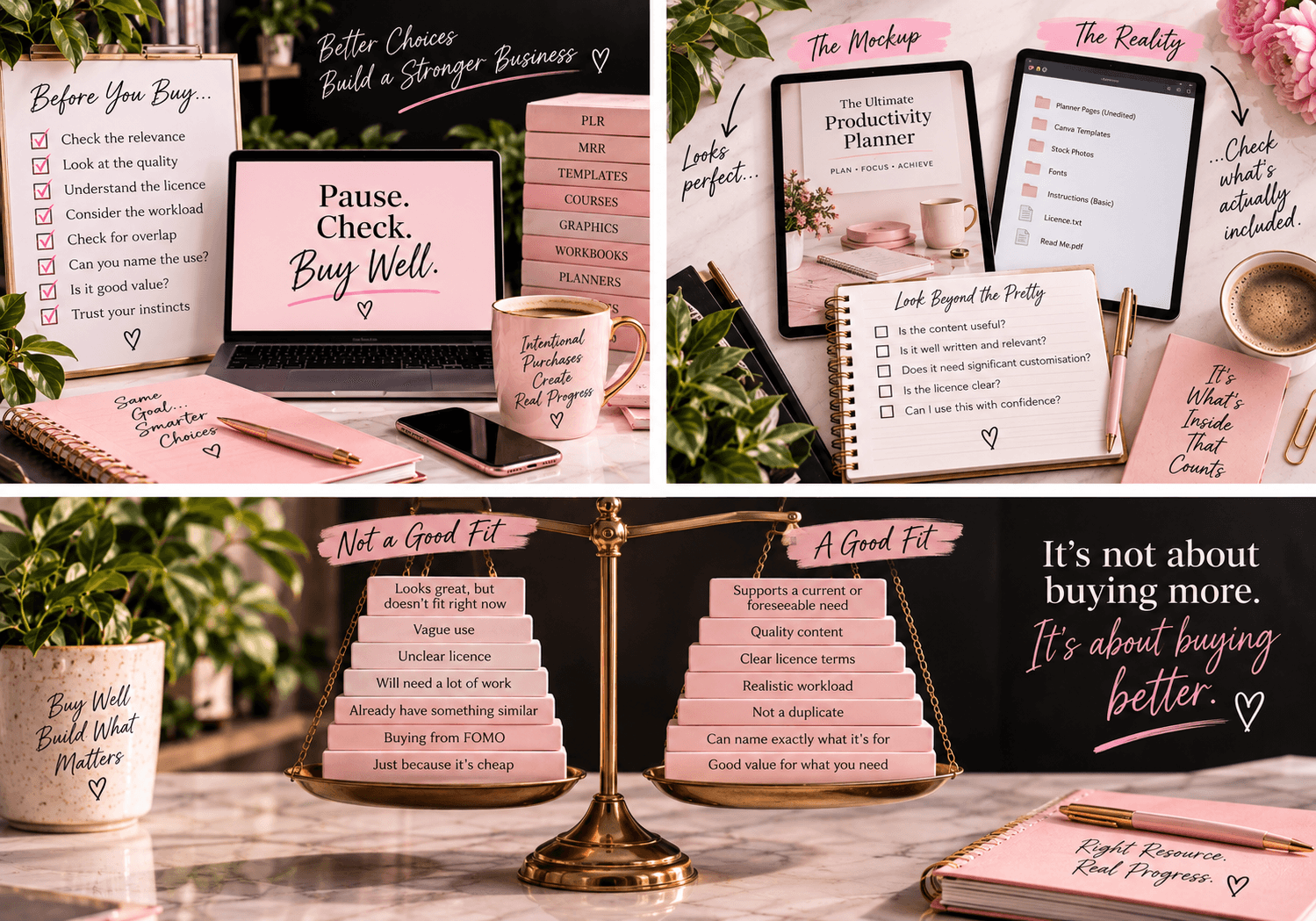
Quality: look past the mockup
Don't judge quality from the mockup or sales page alone. Wherever a seller gives you enough to assess it, look at what you're actually receiving. Is the content useful? Is it coherent? Is it credible and appropriate for the audience you'd actually be using it with? Does it look like something you'd be comfortable putting your name or brand behind, once whatever work is permitted and necessary has been done?
Attractive design doesn't automatically mean quality. A polished cover or a well-styled sales page tells you about the presentation, not necessarily about what's inside. And to be fair, you won't always be able to inspect the full resource before you buy. Where you can assess it, look past the packaging to the material itself. Where you can't, that's simply one more reason licence clarity and realistic workload, both coming up next, matter as much as they do.
Licence clarity: understand what you're actually allowed to do with it
This one matters enormously in this space. A good resource isn't very useful to you if you don't understand what you're actually allowed to do with it.
PLR, MRR and commercial-use labels aren't enough by themselves, because licences vary between sellers and between products. The label is shorthand. The actual licence attached to the actual product is what tells you what's permitted. If the permitted uses or restrictions aren't clear enough for the way you're intending to use the resource, that's a reason to pause and clarify before you buy, not after.
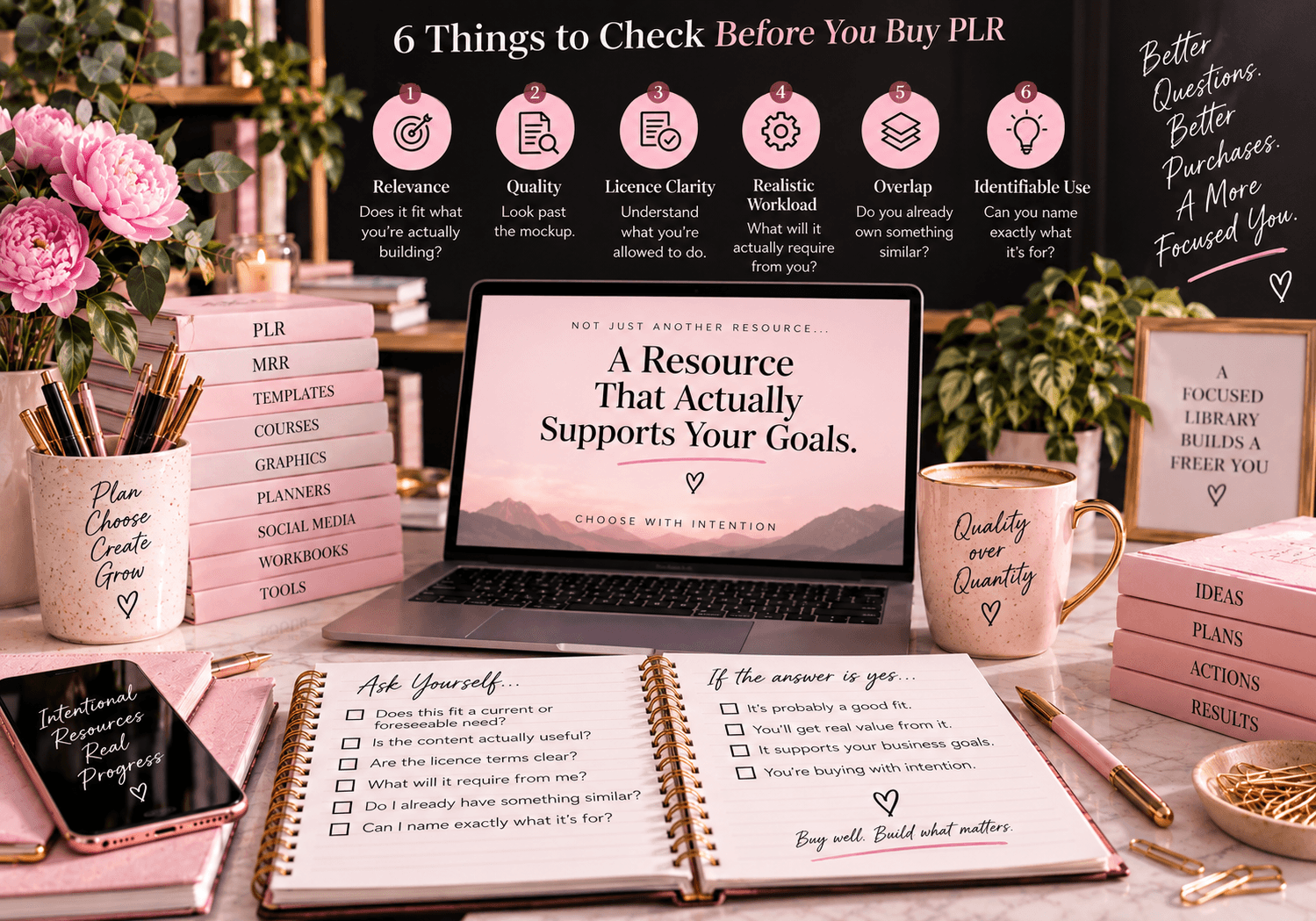
Realistic workload: the gap between the mockup and the finished product
I want to be direct about this one, because it's easy to underestimate. Mockups can make a resource look much closer to finished than it may actually be for your business.
Say you come across a polished mockup for a large ebook bundle. It looks complete, professional, ready to go. Then you sit down to actually use it, and you realise the way you intend to use it would need real review, customisation and setup before it's genuinely usable for your purpose. The resource might still be excellent value. But the workload is part of the buying decision, not something to discover afterward.
Depending on the resource, its licence, and what you're planning to do with it, that workload might mean reading and fact-checking, editing, rebranding, reformatting, sorting links or graphics, repositioning for your audience, uploading, sales-page work, or something else entirely. There's no universal list here. The point is to look past the finished-looking mockup and ask: what will this particular resource actually require from me before I can use it the way I intend?
Overlap: check what you already own
Before buying, check whether you already own something that could do the same job. This isn't a rule against buying anything similar to what you already have. A new resource may genuinely be better, more current, or better suited to what you're doing now than something already sitting in your library.
The point is to make that comparison on purpose, rather than discovering later that you own three versions of essentially the same thing.
Identifiable use: can you actually name what it's for?
This is the one I'd weight most heavily, and it connects directly to something I've written about before: the difference between owning a resource and having a plan to use it.
Before buying, ask yourself: can I name what I'm going to use this for? Not "could I possibly use this," but "what am I buying this to help me do?"
If your answers are things like "this could be useful someday," "there's so much in the bundle," or "I can think of heaps of possibilities," that's worth pausing on. Not an automatic no. A pause. Vague possibility and identifiable use are two different things, and only one of them actually tells you whether this purchase serves you.
What this isn't
I want to be clear that none of this is meant to become a rigid rulebook for when you're allowed to buy PLR. That's not the goal, and it's not how I use these criteria myself. This is about making a deliberate decision, not policing your purchases.
It's also worth saying plainly: a low price doesn't automatically make something good value, and a huge bundle doesn't automatically make it better value. A resource that's genuinely suited to what you need can be better value than a bigger, cheaper one that isn't.
Buy well
The point of all of this isn't to buy less. It's to buy well. I want people buying resources because they understand what they're getting, what they're allowed to do with it, what work it will require, and what they actually want it for.
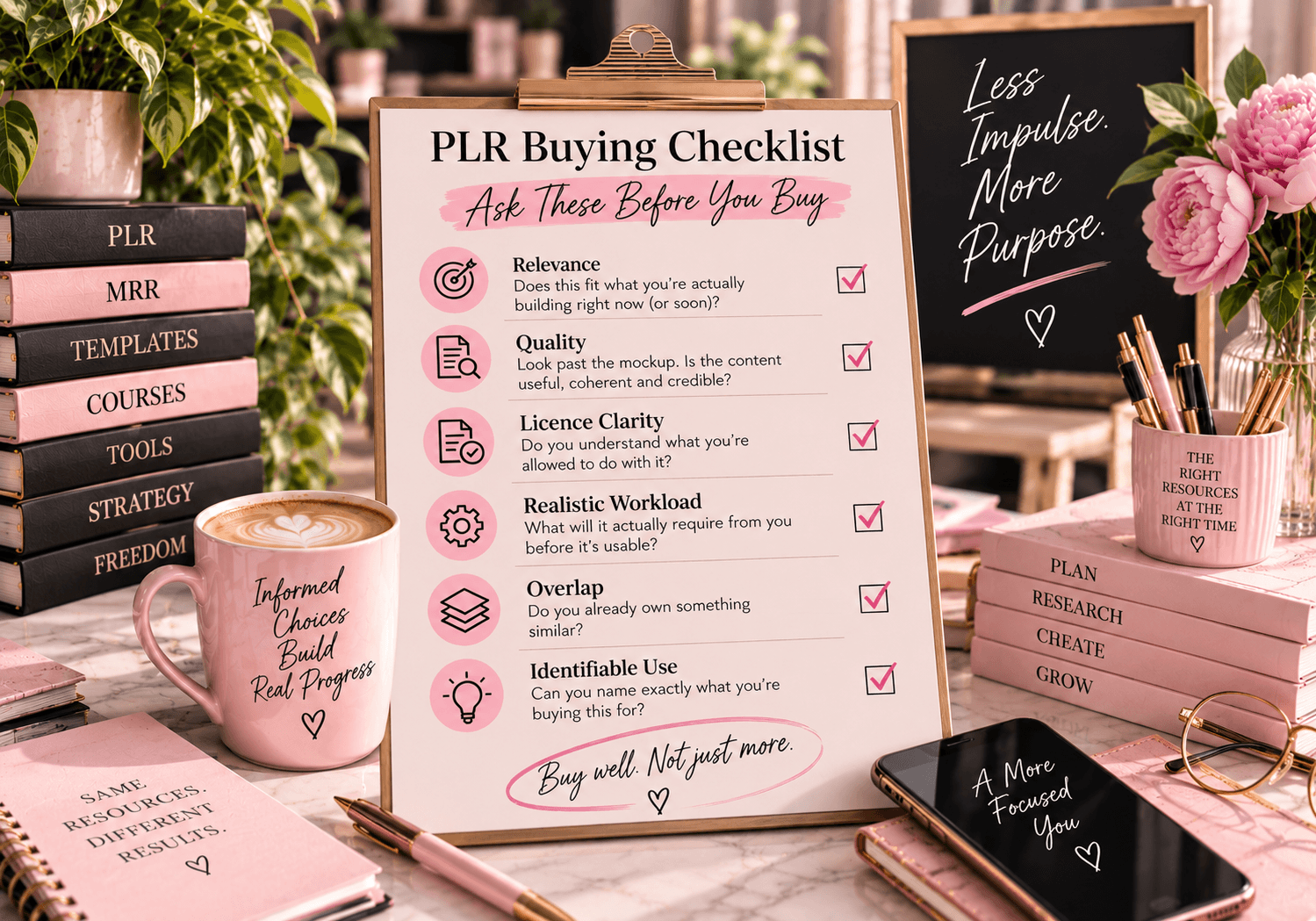
Relevance, quality, licence clarity, realistic workload, overlap, identifiable use. Run a potential purchase past these before you buy, not as a checklist to satisfy, but as a way of making sure the resource earns its place in your library.
Which of these do you check before buying, and which one do you wish you'd asked yourself sooner? Save this one for your next scroll through a PLR sales page.
Written by:
Gaye Fern_PLR Professionals Founder
Categories






Trending
Here's What "Designed by a Seller" Actually Requires.
Your Plan for Using Them Isn't.
It's easy to look at a PLR product and immediately start imagining everything you could do with it

About me

Hi there 👋 My name is Gaye. PLR Professionals is here to help digital product creators use PLR, MRR and ready-made resources with more clarity and confidence. Find practical guidance on licensing, customisation, digital product strategy, marketing and AI—so you can make better use of the resources you already own.
Created with ©systeme.io